In Luzon Province of the Northern Philippines, through mountains and rice
terraces, the road ends at a church, in a small town called Banaue. 4,000 feet above sea level in
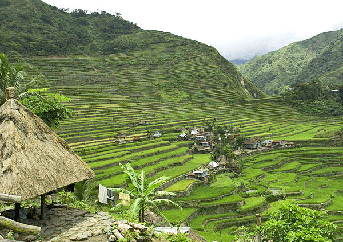
Banaue sits a small market village in Ifugao province. Located north of Manila in the Philippines, Ifugao province is famous
for the handiwork of its people, who increased cultivable lands by carving gigantic rice terraces from the sides of mountains.
For over 2,000 years, the people of Batad have built
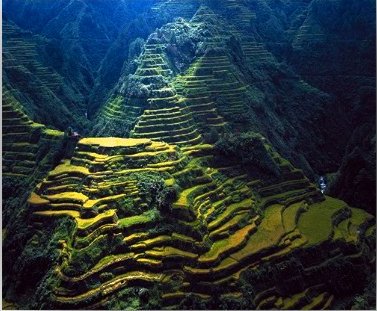
these terraces, one stone at a time. This growing, living stairway stretches
far beyond what the eye can see. Taking an estimated 2,000 years to build, the
still-productive rice terraces rise from the valley floor to heights of up to
3,000 feet, a feat of engineering so substantial that some call them the eighth
wonder of the world. The only man made wonder which was literally sculpted from
the earth. A scarcity of water has led to some rice patties drying up.The
mountainous rice terraces of Banaue and vicinity in the Philippines are mankind’s grandest
scaled engineering feat. The vertical distance between bottom and top rows
exceeds the height of the world’s tallest building. If the terraces were laid
end to end, they would stretch half way around the world.
 |
|
Preservation
The Banaue Rice Terraces of the Philippine Cordilleras was been named as a world heritage site[18][19][20] by the UNESCO World Heritage Centre in 1995. It has passed by UNESCO’s standards[21] due to the blending of the physical, socio-cultural, economic, religious, and political environment as a living cultural landscape. It has passed 3 criteria’s of UNESCO:
 Terrace of paddy fields in Yuanyang County, Yunnan, China. |
sources: wikipedia |
.JPG)
